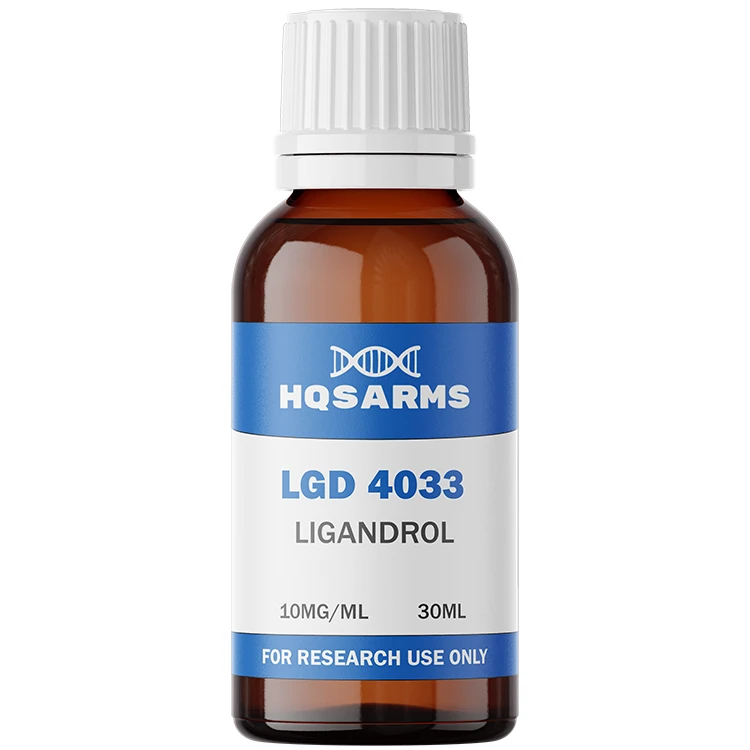


The product record lists LGD4033, LGD-4033, LGD4, and LGD-4 as synonyms, and the compound is also searched as ligandrol, so anyone looking to buy LGD-4033 may arrive under any of those spellings. HQSARMS LGD-4033 is listed as a selective androgen receptor modulator with a CAS number of 1165910-22-4 and a molar mass of 338.25 g/mol.
What is LGD-4033?
LGD-4033 is a selective androgen receptor modulator (SARM), commonly referred to as Ligandrol. Researchers are currently studying the compound to determine its potential to reduce muscle wasting and degeneration. Like most other SARMs, it has been shown to selectively bind to androgen receptors in skeletal tissue. Preclinical animal studies have shown that Ligandrol enhances anabolic activity, leading to increased muscle mass and bone density.
LGD-4033 is one of the most thoroughly researched selective androgen receptor modulators (SARMs) in both preclinical and clinical studies. Its high oral bioavailability, strong anabolic effects, and tissue-selective characteristics make it especially valuable for investigating androgen receptor mechanisms and for potential therapeutic applications related to muscle loss and bone fragility.

How does LGD 4033 work?
LGD-4033 works in a similar manner to anabolic steroids. Both target androgen receptors, leading to increased muscle growth, improved bone density, and faster recovery.
But while anabolic steroids bind to androgen receptors throughout the body, LGD-4033 only targets those in the skeletal muscle.
Key benefits
Increases lean muscle mass
One of the primary reasons Ligandrol (LGD-4033) has garnered significant attention is its ability to promote rapid and substantial lean muscle growth. Users often report noticeable gains within a few weeks of starting a cycle. This effect is largely due to Ligandrol’s role in enhancing protein synthesis, accelerating muscle repair, and stimulating anabolic activity, making it a highly efficient muscle-building agent.
Among investigational SARMs, Ligandrol has demonstrated the highest anabolic activity in preclinical trials, with an anabolic-to-androgenic ratio exceeding 500:1.
Improve bone density
In addition to the impact it has on the prevention of muscle wasting, it also improves bone health by increasing bone mineral density. One of the main goals in the development of LGD-4033 is actually the treatment of osteoporosis.
Potential side effects
While Ligandrol offers numerous performance and muscle-building benefits, it’s essential to understand the potential side effects and associated risks.
Testosterone suppression
One of the main concerns regarding LGD-4033 is its potential to suppress natural testosterone production. Although it is generally less suppressive than traditional anabolic steroids, Ligandrol can still disrupt the hypothalamic-pituitary-gonadal (HPG) axis, leading to reduced levels of luteinizing hormone (LH) and follicle-stimulating hormone (FSH).
This suppression may lead to symptoms such as low libido, fatigue, mood changes, and testicular atrophy, particularly at higher dosages or prolonged use.
Hormonal Imbalances
Ligandrol does not convert to estrogen through aromatization; however, it can still influence overall estrogen levels by affecting the testosterone-to-estrogen balance. Since testosterone suppression occurs without accompanying aromatase inhibition, users might experience an unfavorable hormonal ratio.To mitigate these issues, it is important to monitor hormone levels and implement an appropriate post-cycle therapy (PCT).
Cardiovascular and lipid changes
Ligandrol use has also been associated with reductions in high-density lipoprotein (HDL), or “good” cholesterol, and potential changes to triglyceride levels, particularly at higher dosages. While these effects are reversible post-cycle, they still present a cardiovascular risk, especially for users with preexisting conditions.
Liver toxicity
Another area of concern is liver enzyme elevation, commonly seen with anabolic agents. Although clinical trials of LGD-4033 have not demonstrated significant changes in liver enzyme levels (AST or ALT), higher doses may carry a risk of liver stress.
Common and reported side effects
Although generally well tolerated, Ligandrol has been associated with a range of mild, reversible side effects, including:
- Headaches
- Nausea
- Water retention
- Dry mouth
- Constipation
LGD-4033 dosage and cycle length
Ligandrol is commonly used in a dose between 5 and 20 mg per day, with 10 mg being the sweet spot for most individuals. Since it has a half life of 24 to 36 hours, it is generally taken in a single daily dose.
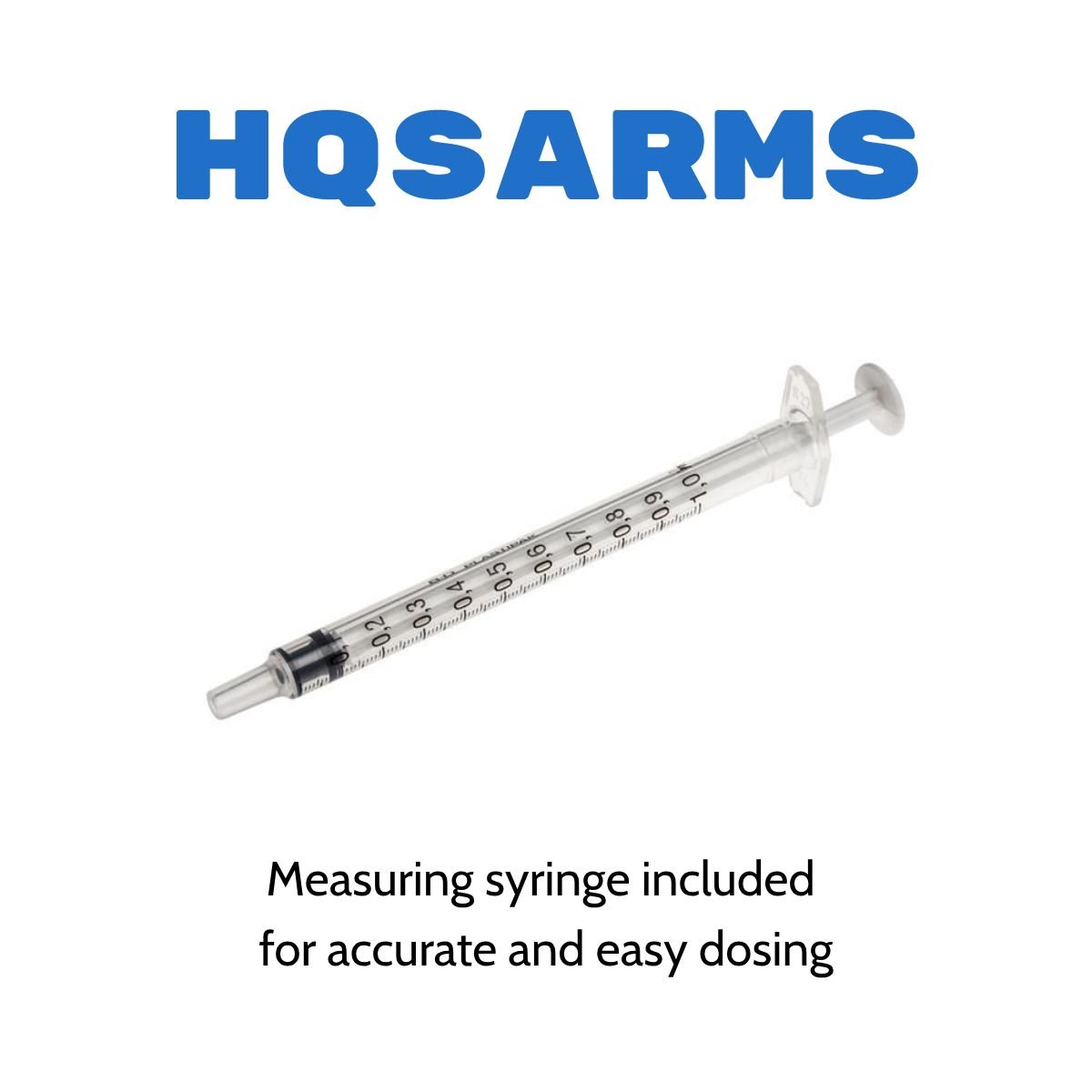
Liquid LGD 4033 has a concentration of 10mg per ml, which equals to a liquid LGD-4033 dosage of 1ml.
The average cycle length for Ligandrol is about 8 weeks.
Legal status
Ligandrol has not been approved by the FDA or EMA for human consumption or therapeutic use. It can therefore not be legally prescribed or sold as a supplement.
LGD-4033 was added to the World Anti-Doping Agency (WADA) list of prohibited substances in 2018, banning its use in professional sports.
HQSARMS Ligandrol (LGD-4033) is strictly intended for research purposes only.
Product specifications
| Application | Selective Androgen Receptor Modulator |
| Form | Liquid |
| Concentration | 10 mg per ml |
| Composition | 5% Ethanol, 94% PEG-400, 1% LGD-4033 |
| Storage | Room temperature, out of direct sunlight |
| Storage life | 2 years |
| CAS | 1165910-22-4 |
| Molecular Weight | 338.25 g/mol |
| Chemical Formula | C₁₄H₁₂F₆N₂O |
| IUPAC Name | 4-(2-(2,2,2-trifluoro-1-hydroxyethyl)pyrrolidin-1-yl)-2-(trifluoromethyl)benzonitrile |
| Synonyms | LGD4033, LGD 4033, Ligandrol, UNII-1EJT54415Am, VK-5211, 1EJT54415A, SCHEMBL221159, CHEMBL5170587 |
Frequently asked questions
Is LGD-4033 a SARM?
Yes. LGD-4033 is a non-steroidal selective androgen receptor modulator built on a pyrrolidinyl-benzonitrile scaffold, so it is not a steroid and not a peptide. Researchers study it as a tissue-selective androgen receptor ligand in receptor pharmacology and analytical reference work.
Are lgd4, lgd 4 and lgd-4 the same thing as LGD-4033?
Yes. Those spellings are just truncated shorthand for LGD-4033, usually typed by people who remember the prefix but not the full number. No distinct compound named LGD-4 exists. Each variant refers to the same selective androgen receptor modulator supplied on this page.